
In large construction and infrastructure projects across Saudi Arabia, selecting the wrong valve can lead to costly downtime, pressure loss, or even system failure. Many project managers and procurement teams struggle to identify the right types of gate valves that match the demands of water networks, oil pipelines, or industrial systems.
Choosing the correct valve is not just a technical detail; it directly impacts reliability, safety, and long-term maintenance costs. Understanding the different gate valve types and specifications helps contractors select the most suitable solution for pressure control, flow isolation, and system durability in harsh operating environments common across the Kingdom.
What is a Gate Valve and How Does it Work?
A gate valve is a linear motion valve designed to start or stop fluid flow in pipelines. Instead of regulating flow like other valves, its primary purpose is complete isolation, either fully open or fully closed.
The valve operates through a gate or wedge that moves vertically inside the body of the valve. When the handwheel or actuator turns, the gate rises to allow flow or lowers to block it completely.
Key Gate Valve Components
The main parts of a gate valve typically include:
- Valve Body: The main structure that holds all internal components and connects to the pipeline.
- Gate (Disc): The internal barrier that moves up or down to stop or allow fluid flow.
- Stem: Transfers motion from the actuator or handwheel to the gate.
- Bonnet: Covers the valve body and protects the internal assembly.
- Seat Rings: Provide sealing surfaces to ensure zero leakage when the valve is closed.
- Actuator or Handwheel: The mechanism used to operate the valve manually or automatically.
How Gate Valves Function in Construction Systems
Gate valves are widely used in Saudi infrastructure and industrial projects because they offer:
- Full-bore flow with minimal pressure drop
- Reliable shut-off capability
- Durability in high-pressure systems
- Compatibility with large pipeline networks
For this reason, they are commonly installed in:
- Water distribution networks
- Oil and gas pipelines
- Fire protection systems
- Industrial processing plants
- HVAC infrastructure
Contact El-Buroj on WhatsApp for quick support with all your plumbing supply needs.

Detailed Breakdown of Types of Gate Valves in KSA
Saudi construction projects require valves that can withstand high pressure, temperature fluctuations, and demanding industrial conditions. Below are the most common gate valve types used in infrastructure and industrial projects.
1. Wedge Gate Valves
The wedge gate valve is one of the most widely used types of gate valves in construction and industrial systems. It features a wedge-shaped gate that fits tightly between two inclined seats to create a strong seal.
This design makes wedge valves ideal for high-pressure systems where tight shut-off is essential.
Key Features
- Strong sealing capability
- Suitable for high-pressure pipelines
- Durable under temperature variations
- Reliable in water, oil, and steam systems
Common Applications in Saudi Projects
- Municipal water supply systems
- Oil and gas pipelines
- Power plants
- Industrial processing facilities
2. Knife Gate Valves
The knife gate valve is designed for systems that handle thick fluids, slurry, or suspended solids. It uses a sharp-edged gate that cuts through heavy media, allowing the valve to close effectively even in challenging conditions.
Key Features
- Sharp-edged gate for cutting through solids
- Lightweight construction
- Ideal for slurry or viscous fluids
- Cost-effective solution for industrial systems
Typical Uses
Knife gate valves are frequently used in:
- Wastewater treatment plants
- Mining operations
- Pulp and paper industries
- Industrial slurry transport systems
3. Slab / Through-Conduit Gate Valves
The slab gate valve, also known as a through conduit gate valve, is specifically designed for oil and gas pipelines. Its internal design allows for a full-bore opening that aligns perfectly with the pipeline diameter.
Key features:
- Full-bore flow path
- Reduced pressure loss
- High reliability in pipeline systems
- Strong sealing performance
Where They Are Used
- Long-distance oil pipelines
- Gas transmission systems
- Petrochemical plants
- Refinery operations
4. Parallel Slide & Expanding Gate Valves
Parallel slide gate valves use two parallel discs that slide against seats to create a seal, Unlike wedge valves, they do not rely on mechanical wedging to achieve tight closure.
Advantages
- Reduced friction during operation
- Lower wear on sealing surfaces
- Reliable performance in high-pressure pipelines
- Effective sealing in both upstream and downstream directions
Common Applications
These types of gate valves are typically installed in:
- Steam pipelines
- Oil refineries
- High-temperature industrial systems
- Power generation plants
Types of Gate Valve for Water Supply in Saudi Arabia
In most Saudi water distribution networks, several gate valve types are commonly used based on pipeline size, pressure requirements, and installation location. The most widely adopted options include:
1. Resilient Seated Gate Valves
These valves are widely used in municipal water networks because they offer excellent sealing performance and corrosion resistance. The gate is coated with an elastomer layer that creates a tight seal against the valve seat.
Key advantages include:
- Leak-tight sealing even after years of operation
- High resistance to corrosion and mineral deposits
- Suitable for underground water distribution lines
- Minimal maintenance requirements
2. Metal Seated Gate Valves
Metal seated valves are designed for systems that operate at higher temperatures or pressures. Instead of an elastomer coating, the gate and seat are made entirely from metal, which allows the valve to tolerate harsher operating conditions.
These gate valve types are typically installed in:
- Industrial water systems
- Cooling water lines in power plants
- Large pumping stations
- High-pressure pipeline networks
3. Rising Stem Gate Valves
In a rising stem design, the valve stem moves upward when the valve opens. This allows operators to easily see whether the valve is open or closed, which is especially useful in water treatment plants and pumping facilities where visual inspection is required.
Key benefits include:
- Clear visual position indication
- Easier maintenance and inspection
- Reliable operation in above-ground installations
4. Non-Rising Stem Gate Valves
Non-rising stem valves are commonly used in underground pipelines where space is limited. The stem rotates internally while the gate moves up or down, meaning the stem height remains fixed.
These valves are frequently used in:
- Underground municipal pipelines
- Irrigation networks
- Compact valve chambers
Explore quality plumbing products from trusted brands like Mueller, Norika, and NEPROPLAST at El-Buroj.
Looking for reliable gate valves for your project?
Get high-quality valves with competitive pricing and fast delivery.
Main Parts of a Gate Valve: Components and Specifications
To fully understand how different types of gate valves perform in industrial systems, it is essential to examine the gate valve components and their engineering specifications. Each element inside the valve plays a crucial role in controlling flow, maintaining pressure integrity, and ensuring long-term reliability.
The main parts of a gate valve include several structural and mechanical elements designed to work together for efficient flow isolation.
1. Valve Body
The valve body forms the main pressure retaining structure of the valve. It connects directly to the pipeline and houses all internal components. In most industrial gate valve types, the body is manufactured from durable materials such as:
- Cast steel
- Ductile iron
- Stainless steel
- Bronze (for smaller valves)
2. Gate (Disc)
The gate is the central element responsible for stopping or allowing fluid flow. Depending on the type of gate valve, the disc may be wedge shaped, parallel, or slab-designed. When the valve opens, the gate lifts fully out of the flow path, allowing unrestricted movement of fluid through the pipeline.
3. Stem
The stem connects the actuator or handwheel to the gate and transfers motion during operation. Stems can be categorized into two designs:
- Rising stem – moves upward when opening the valve
- Non-rising stem – rotates internally while remaining stationary externally
4. Bonnet
The bonnet is attached to the valve body and protects internal components. It also provides access for maintenance and replacement of internal gate valve components.
5. Seat Rings
Seat rings create the sealing surfaces that prevent leakage when the valve closes. Precision machining ensures tight contact between the gate and seats, which is essential for reliable shut-off performance.
6. Packing and Gasket
These sealing elements prevent leakage around the stem and between valve components. High-quality packing materials are particularly important in high-pressure industrial systems.
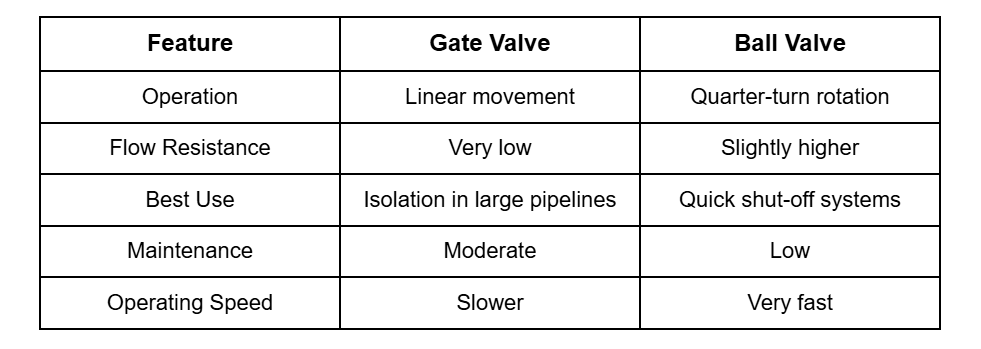
Gate Valve vs. Ball Valve: Which One Should You Choose?
Choosing between these plumbing products depends on system requirements, operating frequency, pressure conditions, and maintenance expectations.
Gate Valve Advantages
A gate valve is ideal for systems where the valve remains either fully open or fully closed for long periods.
Key advantages include:
- Minimal pressure drop due to full-bore flow design
- Excellent shut-off capability for large pipelines
- Reliable performance in high-pressure systems
- Suitable for water, oil, gas, and steam applications
Because of these benefits, many infrastructure projects in Saudi Arabia rely on different types of gate valve for primary pipeline isolation.
Ball Valve Advantages
A ball valve uses a rotating ball with a central bore to control fluid flow. When the handle turns 90 degrees, the bore aligns with the pipeline and allows flow.
Ball valves are often preferred for systems that require:
- Fast opening and closing
- Frequent operation
- Compact installation spaces
- Lower torque during operation
Why Source Your Gate Valves from El Buroj?
Choosing the right supplier is just as important as selecting the correct types of gate valve for your project. With more than 10 years of experience in the Saudi construction market, El Buroj Saudi Company has become a trusted supplier for contractors, developers, and infrastructure projects across the Kingdom.
El Buroj provides reliable gate valve types and specifications along with a wide range of construction materials that meet the demands of small, medium, and large-scale projects.
Why contractors choose El Buroj:
- Proven industry experience since 2014, serving Saudi Arabia and GCC markets.
- Trusted partnerships with global brands such as Schneider Electric, Legrand, Riyadh Cables, and Bahra Cables.
- Comprehensive supply solutions covering plumbing materials, electrical systems, cables, and mechanical equipment.
- Strong track record supplying major national projects, including developments connected to Umm Al-Qura University and initiatives supporting the Saudi Tourism Authority.
- Convenient branch network in Jeddah and Riyadh with reliable customer support.
By working with El Buroj, you gain access to high-quality valves, reliable sourcing, and a supplier that understands the real needs of construction projects across Saudi Arabia.
Not sure which plumbing products fit your project?
Get a free consultation from El-Buroj experts and choose the right solution with confidence.
FAQs about types of gate valve in KSA
What are the different types of gate valves?
Common types include wedge gate valves, parallel gate valves, slab gate valves, knife gate valves, and rising or non-rising stem gate valves, each designed for different piping applications.
What are the different types of wedges in gate valves?
The main wedge types are solid wedge, flexible wedge, and split wedge, which vary in sealing performance and ability to handle pressure or temperature changes.
What are the four main types of valves?
The four main valve types are gate valves, ball valves, globe valves, and butterfly valves.
What is API 598 standard?
API 598 is a standard that defines inspection and pressure testing requirements for valves to ensure quality and proper sealing.
What are the six types of valves?
Six common valve types are gate, ball, globe, butterfly, check, and plug valves.
What are different types of gates?
Gate valves mainly use wedge gates, parallel slide gates, and knife gates for different flow control needs.